Glider Design Features
World is in constant progress. Paraglider design is no different.
Accumulating years of experience Dudek arrived at a number of proven solutions:
Push & Relax Technology
 Push&Relax technology - PPG canopies marked with this symbol demonstrate exceptionally stable flight on full speed bar, that is at high speeds. Push&Relax technology - PPG canopies marked with this symbol demonstrate exceptionally stable flight on full speed bar, that is at high speeds.
Why stability at high speeds is so important?
In free-flying speedbar is used time to time, most often as a radical measure to escape from sink area or as a defence against being blown back into lee. Still, there are many pilots who do not use speed bar at all. That's why designers so far paid little attention to paragliders stability in such configuration. On the contrary, in PPG flying a speed bar is used commonly. It is only a pilot who decides the route, not the thermals location or terrain characteristics. It is nothing uncommon when a pilot takes off, opens the trimmers, engages speed system and gets on an umpty kilometres route. In such case lack of stability and comfort would be really distressing.
How does lack of stability manifest itself?
Good stability of your canopy can be compared to proper balancing wheels in your car. When you drive slowly, this is not much of a problem, but the faster you drive the more evident vibration you get. Badly stabilized canopy will move accordion-style, quiver and resonate, causing pilot to be afraid of using speed system (and rightly so).
Why the canopy becomes unstable?
It's really all about balancing - a canopy can be trusted when the tensions run evenly all along its surface. While great majority of designers take pains to make sure their paragliders are evenly tensioned at trim speed, they are neglecting stability at max speed. That's a big mistake since increased ram effect, air pressure inside the wing and increased lift in individual areas can drastically alter distribution of loads and tensions. If it was not taken into account, the paraglider will quiver and behave accordion-wise.
How did we succeed in effective stabilising the canopy?
Push&Relax Technology is centered around fully reflex aerofoil. Basically that's why it is tuck-resistant and self stabilizing in all directions. Still, just using the reflex aerofoil is not enough. Structure of inner reinforcements, precise shape of individual surface panels tensioning all aerodynamical surfaces together with leading and trailing edges have to be carefully combined, so that canopy will remain properly tensioned not only at 40 km/h, but also at 60. In order to succeed you have to include research, a lot of trials, sophisticated software and first of all huge practical experience.
We did all of that and even more. In effect when flying Dudek paragliders marked with Push&Relax Technology sign you can safely put the pedal to the metal and enjoy fast flight.
Canopy Shape Guard
 CSG - Canopy Shape Guard - is our unique system controlling canopy coherence. It is because of this system that our wings are equally tensioned, smooth, stable and... simply remarkable. CSG - Canopy Shape Guard - is our unique system controlling canopy coherence. It is because of this system that our wings are equally tensioned, smooth, stable and... simply remarkable.
CSG consists of a number of lesser systems:
- VS (V-shaped Supports) - they are there to ensure upper surface smoothness, exact aerofoil reproduction on entire wing span, better load distribution and possible small number of suspension points.
- RSS (Reinforcing Strap System) - an independent reinforcements net on lower surface, strengthening and stiffening all construction.
- OCD (Optimized Crossports Design) - the intercellar openings have carefully designed shapes and are optimally placed between stress lines in the ribs, in order to ensure efficient pressure distribution in the canopy and its quick inflation.
- CCS (Closed Dell Structure) - this is a number of closed cells in most important locations. It?s goal is to hinder the backflow from the cells out and thus to facilitate their refilling and canopy recovery in case of a collapse.
Canopy Shape Guard effectively stiffens the wing along all its span, practically eliminating any lateral canopy work. Its only flaw are the increases in weight (about 1 kg), material- and labour consumption, and of course in overall costs. Yet it is well worth the sweat, as in turn we get a no-compromise product of highest performance and quality, that above all is able to keep its planned parameters for a long, long time.
Not every wing features all DRA subsystems - you will find details in each wing description.
Dudek Reflex Airfoil
 DRA - Dudek Reflex Airfoil -applied in PPG wings fully autostabilised arofoil, based on long years of research and experience. In our variant we managed to get rid of typical flaws associated with these aerofoils. DRA - Dudek Reflex Airfoil -applied in PPG wings fully autostabilised arofoil, based on long years of research and experience. In our variant we managed to get rid of typical flaws associated with these aerofoils.
Dudek Optimized Airfoil
 Dudek Optimized Airfoil It incorporates all our experiences stemming form previous designs and as a special feature is optimized with dedicated engineering software. Dudek Optimized Airfoil It incorporates all our experiences stemming form previous designs and as a special feature is optimized with dedicated engineering software.
ALC - Alternative Steering System
 The new system is based on a solution developed by Michel Carnet on his ReAction since 2007, at the World Championship in China. The new system is based on a solution developed by Michel Carnet on his ReAction since 2007, at the World Championship in China.
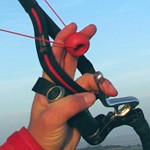 ALC allows for aggressive, yet effortless, turns on full speed without influencing its reflex aerofoil. It is especially important in the case of bigger canopies, inherently haunted by significant steering forces and low agility. ALC allows for aggressive, yet effortless, turns on full speed without influencing its reflex aerofoil. It is especially important in the case of bigger canopies, inherently haunted by significant steering forces and low agility.
The new steering component is a red ball, easily positioned to fit various harness hang-points and personal preferences. In addition, the ALC ball and line are routed in such a way to be easy to use without the risk of entanglement with risers or other parts. Of course you can use just the standard brakes if you wish, ignoring the ALC ball.
The current version of ALC is honed to perfection by long trials of numerous designs. All signs show that it will soon become a standard in alternative PPG control systems.
TST - Tip Steering Toggles
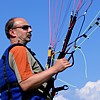
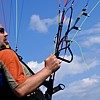
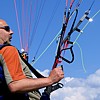
 Our original idea, featuring additional miniature handles that steer the stabilizers. It is a great improvement on long flights, when opened trimmers and full speedbar make steering much harder. Our original idea, featuring additional miniature handles that steer the stabilizers. It is a great improvement on long flights, when opened trimmers and full speedbar make steering much harder.
Prior to grabbing miniature TST-handles (Tip Steering Toggles) pilot places the main steering handles in a special Toggle Docking Stations, equipped with strong neodymium magnets. In this way you can comfortably steer the wing via TST handles, not worrying about the brakes getting tangled.
Risers functionality
We are constantly adapting riser design to growing needs of our customers. Each riser is marked with different colour. All risers have an optionable speed-system.
ELR - Easy Launch Riser
 Split 'A' riser makes for easier launch and 'big ears' Split 'A' riser makes for easier launch and 'big ears'
As in all other elements of the wing, the risers too must be constantly adjusted to the ever-increasing needs of the pilots. As a standard, every Dudek wing is equipped with a split A riser. Most of the lines go to the main riser, and the additional one has just one or two outer lines.
There are two advantages such a solution. Firstly, the big ears are a lot easier to introduce - you no longer have to reach high above the quick-links, and the taut lines do not hurt your fingers. Secondly, a start is much easier, too. With a dynamic push every wing has a tendency to form a horseshoe, i.e. to inflate the tips faster than the centre. The pilot can reduce this effect by grabbing only the main A risers, leaving the outer part hanging. The leading edge will then be pulled only in the central part and the tendency for the tips to speed up will be eliminated.
When the wing is in the air, you can recognise the risers without hesitation. But when the wing is lying on the ground it can be difficult, especially while preparing for a reverse launch and the risers just form a twisted bundle. That's why we have distinctly marked the main A risers with yellow tape, so it is easier for you to find the correct risers and your instructor can instantly see if you are right.
Trim
 A trimming system for additional angle of attack regulation. Used mainly in PPG wings. A trimming system for additional angle of attack regulation. Used mainly in PPG wings.
This system features replaceable trim straps. After prolonged or intensive operation they need to be replaced, as they get damaged by buckle edges.
Our new trimmer straps have a visible scale with negative (blue) and positive (red) areas and marked neutral position. Getting the buckle in red area means that the wing is flying faster, while moving it in the blue causes the wing to fly slower. Neutral position is a suggested take-off position, notwithstanding that each pilot will have his/her own preferences worked out in time. Applied markings help you remember characteristic settings, e.g. max speed in level flight, easy take-off in strong wind etc.
Straps are finished with loops for easier operation.
EK - Easy Keeper
 Indigenous way to hold the brake handles at the risers that keeps them firmly in place, while both attaching and releasing goes smoothly and easily. Indigenous way to hold the brake handles at the risers that keeps them firmly in place, while both attaching and releasing goes smoothly and easily.
TCT - Triple Comfort Toggle (New!)
 An easy conversion from hard through medium to soft brake handles. An easy conversion from hard through medium to soft brake handles.
DCT - Double Comfort Toggle
 Makes possible to have your brake handles as you like them, in stiff or soft configuration. Makes possible to have your brake handles as you like them, in stiff or soft configuration.
The new steering component is a red ball, easily positioned to fit various harness hang-points and personal preferences. In addition, the ALC ball and line are routed in such a way to be easy to use without the risk of entanglement with risers or other parts. Of course you can use just the standard brakes if you wish, ignoring the ALC ball.
 TEA - Torque Effect Adjuster TEA - Torque Effect Adjuster
The task of this feature is to counteract the effect of engine torque, that tends to make the paraglider turn in the direction opposite to the propeller's rotation. TEA balances the torque by adjusting the length of some wingtip lines, and it can be adjusted to match you specific combination of paramotor/propeller. Simple to use, effective and easy to toggle on & off in the air.
 FET - Flexi Edge Technology FET - Flexi Edge Technology
Application of flexible synthetic rods was tried for the first time in the Hadron wing. Then, positive experience led us to use this technology in many other designs of various classes. The rods make the leading edge stiffer and smoother, bringing improvements in many areas - from easier inflation, through stiffening the canopy in flight to improved general airflow.
Another advantage is possibility of using three rows of suspension lines instead of four, thus decreasing parasitic drag and distinctly improving overall performance.
Cleaning Slots
 ACS - Auto Cleaning Slots ACS - Auto Cleaning Slots
Dedicated slots automatically removing dirt from the wing tips.
 CS - Cleaning Slots CS - Cleaning Slots
Located at the wing tips make removal of dirt a way easier.
|